


Candidates outline their positions on issues facing the city
Graham voters face a full ballot this year, as two candidates are vying for mayor and four are competing for two seats on the city council. The mayor’s race pits incumbent Jennifer Talley against first-time challenger Chelsea Glen Dickey.
First-time incumbent Bobby Chin, elected in 2021, is seeking reelection, and three other candidates are joining him on the ballot for the two available council seats. They include Daniel Alvis, Randy Phillips, and Jim Young. Joey Parsons, who had been elected with Chin in 2021, did not seek reelection and, in fact, resigned recently because he moved outside of the city.
Alvis previously sought a council seat in 2021, when he placed fifth out of seven candidates on the ballot that year for two seats. Young is also a previous candidate, having run unsuccessfully for mayor back in 2017 against then-mayor Jerry Peterman. Phillips is a first-time candidate.
What to do about Sesquicentennial Park
One of the key issues that divides the candidates is what to do about Sesquicentennial Park whose brick floor has been sinking at its current location at the northwest corner of Court Square across from the Historic Court House. Last year, it reached such a point that the city closed the park for safety reasons.
[Story continues below photos of Sesquicentennial Park on the northwest corner of Court Square.]


The only candidate who is four-square in favor of closing the park and moving its components elsewhere is Chin.
Meanwhile, Talley, who has generally said over the past two years that she doesn’t want to expend tax dollars on the park’s repair or renovation now says she wants to find out what a majority of Graham residents want the city to do.
At city council meetings over the past year, Talley has previously said that she thinks the price tag for repair will be exorbitant. Last year, during a city council meeting, she stated, according to minutes from the meeting, that repairs “would be excessive and it would not make taxpayer sense to continue maintaining the property.”
In response to this year’s election issues questionnaire, Talley describes herself as “undecided” about the possibility of two alternative locations that have been suggested: one in a small courtyard behind the city’s historical museum along West Elm Street and the other beside the Graham Civil Center on McGee Street.
See questionnaire and candidate responses specifically on Sesquicentennial Park HERE:
Chin, who had previously suggested the civic center site, is now opposed to it as an alternative location. He supports the relocation to the area behind the historical museum.
Meanwhile, each of the challengers is generally for keeping the park where it is and spending the necessary money to fix it.
Dickey, Phillips, and Daniel spoke last month at a city council public hearing on the park, each arguing for it remain where it is, and each, along with Young, say they favor keeping it at its current location.
All except Young say they would have voted against a Chin motion back in May to: “disassemble the pergola at Sesquicentennial Park, pick up the memorial bricks, and do what is necessary as defined by Public Works to make that piece of property safe, and then consider declaring the land surplus and putting it up for sale.”
The vote passed 3-2, with mayor pro tem Ricky Hall and Parsons opposed. Chin, council member Bonnie Whitaker, and Talley voted in favor. But the city has not yet begun the process of disassembling the park.
In response to this year’s questionnaire, Dickey says, “The park should remain in its original location, preserving its historic and community significance rather than relocating it elsewhere.”
Those who advocate for repair suggest varying ceilings on the level of expected taxpayer funding – from $350,000 (Young) to possibly $500,000 (Alvis) or $600,000 (Dickey).
Alvis, Phillips, and Young suggest that the city should explore potential grants to help fund the repairs at the park, and Dickey points to a previously-awarded state grant to Graham, for $600,000, that she says could have been used for that purpose.
Young says, “We should explore grant funding, public-private partnerships, or modest budget allocations. Most importantly, we should let the public weigh in – possibly through a voter referendum.”
Alvis also points to the possibility of “‘some sweat equity,’ available in the community if we wanted to make this a ‘weekend warrior’ project over the course of several months.”
Candidates were also asked about ideas raised during a recent city council hearing, in September, about potential alternative methods for shoring up the ground underneath the park without the need to dig up the whole site – and why they think the city hasn’t explored those possibilities.
At the public hearing, Alvis referred to a process of what he termed “flowable fill” that could be injected underneath the park’s foundation to stabilize it.
Dickey has the most direct attribution of motive for the failure to explore alternatives. “ Talley is not presenting apples-to-apples cost comparisons for the community at council meetings. Council’s intent appears to be moving forward with relocation, which explains the lack of exploration.”
For her part, Talley says, “I asked about this and was told that because there is wood and debris under the park that continues to deteriorate over time, this might not be a viable solution, but I am open to any ideas on how we can repair the park more cost effectively and without raising taxes.”
Taxes and spending
All six candidates pronounced themselves as satisfied that the current tax rate in Graham is “about right.”
Candidates were asked to rate five categories of potential spending as high, moderate, or low priorities.
Five of six candidates ranked adding more police officers to the Graham Police Department has a “high” priority; Alvis said “moderate.”
Additional firefighters for the fire department was a category ranked “high” by most candidates, except for Alvis and Young, both of whom ranked the category as “moderate.”
Dickey, Talley, Chin, and Phillips also ranked a satellite fire station as a “high” priority, with Alvis and Young also ranking that as “moderate.”
Five of six candidates ranked additions and expansions at Graham Regional Park on Jim Minor Road as a “moderate” priority; Phillips ranked it as “low.”
And four candidates (Talley, Alvis, Chin, and Young) ranked as a “low” priority the city’s participation in Burlington’s bus service, Link Transit. Dickey and Phillips ranked it as “moderate.”
In terms of whether they would be willing to vote to raise property taxes in order to fund any of their “high” priorities, most were reluctant.
Said Talley, “We’ve been able to fund these important projects without raising taxes by securing state and federal grants.”
“Public safety” was the area that drew the most sympathy for raising taxes from Dickey and Young. Chin would consider increasing taxes to provide more police officers “only as a last resort.”
Phillips would consider it for the fire department. “Increasing the department would lower ISO rating and possibly lower insurance rates for residents,” he said.
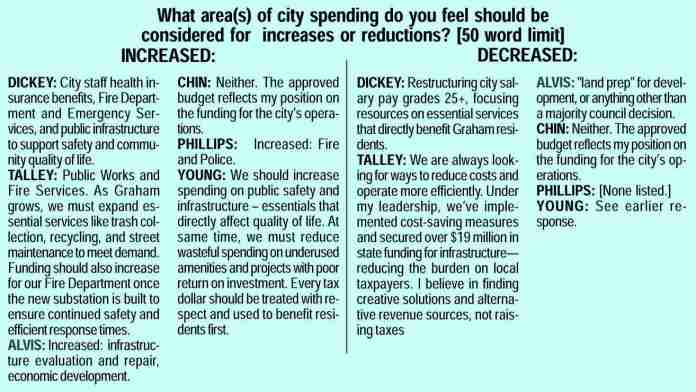
[Story continues below candidate positions on areas where they recommend increased/decreased municipal spending.]
Graham’s growth: too fast, too slow, about right?
Candidates were asked their views on the pace of development in Graham – in commercial, residential, and industrial spheres.
Most candidates (Talley, Alvis, Chin, and Young) say commercial development is “about right,” while Dickey feels it is “too low.”
For residential growth, Dickey, Alvis, and Chin believe the rate of growth is “about right,” while Talley and Young believe it is “too high.”
In industrial development, Talley, Chin, and Young say the pace of development is “about right,” while Dickey and Alvis say it is “too low.”
Phillips did not respond to the questions about Graham’s growth.
Advisory boards
Candidates were split about whether there should be limits on the number of advisory boards Graham residents can serve on, how long they should serve, and whether council members’ relatives should be eligible for service.
In recent years, three council members’ spouses have been appointed or reappointed to various advisory boards – Chin’s wife, Karen; mayor pro tem Ricky Hall’s wife, Judy; and Talley’s husband, Chuck.
Talley, Chin, and Phillips say there is no need for term limits, while Dickey, Alvis, and Young favor term limits, ranging from two or three terms, with up to six years of total service.
Dickey and Alvis said appointment to one advisory board at a time was sufficient, while Talley, Chin, Phillips, and Young said as many as two boards was appropriate.
Candidates were also asked, “Should spouses or other close family members of city council members be eligible for appointment to advisory boards?” Talley and Chin said “yes,” while other candidates were opposed.
Dickey noted that allowing family members “seems like a conflict of interest.” She added, “With a city of 20,000 people, it’s important to ensure all voices are heard and represented, rather than offering opportunities to council members’ families.”
Similarly, Alvis said, “There could be conflict with spouses and [the] potential influence elected official may have on them.”
But Talley said, “I don’t think that someone being on the city council should preclude their family member from participating in public service.”
Adequacy of notifications to surrounding property owners
Candidates were asked about the adequacy of notices sent by the city through first class mail. The city’s planning department had told the newspaper that notices are sent to property owners within 150 feet of a proposed rezoning request. [The planning board chairman subsequently told the newspaper that the notifications go to those within 250 feet.]
In either case, Graham’s notifications are to a narrower range than is done in Mebane (300 feet) or Burlington (400) feet.
All candidates except Chin felt that Graham’s radius was not sufficient and could be expanded, with most who suggested specifics, giving examples of 300 to 400 feet.
Candidates were asked about other issues, including the Confederate monument on the north side of the Historic Court House, their assessment of racial issues in the city, the adequacy of council pay, and certain zoning controversies.
The candidates’ biographies begin here: https://alamancenews.com/meet-the-candidates-for-mayor-and-city-council-in-graham/, with the main questionnaire beginning HERE, a questionnaire focusing specifically on Sesquicentennial Park HERE, and questions on how non-incumbents would have voted on two issues from earlier this year, as well as individual questions specific to each candidate at the end of this story.
[Editor’s Note: Candidates were given limits of 15 words for most questions, with some questions allowing as many as 25 or 50 words. Candidates had been instructed that in the event they provided longer answers, their responses would be edited to conform to the newspaper’s stated limits.
[Extensive editing was needed for many of the Graham candidates’ responses this year, with some exceeding the stated limits by as much as two to three times. The newspaper tried to capture the essence of each candidate’s answer, often using most of the first 25 or 50 words, respectively, of a response that exceeded the word limits.]


